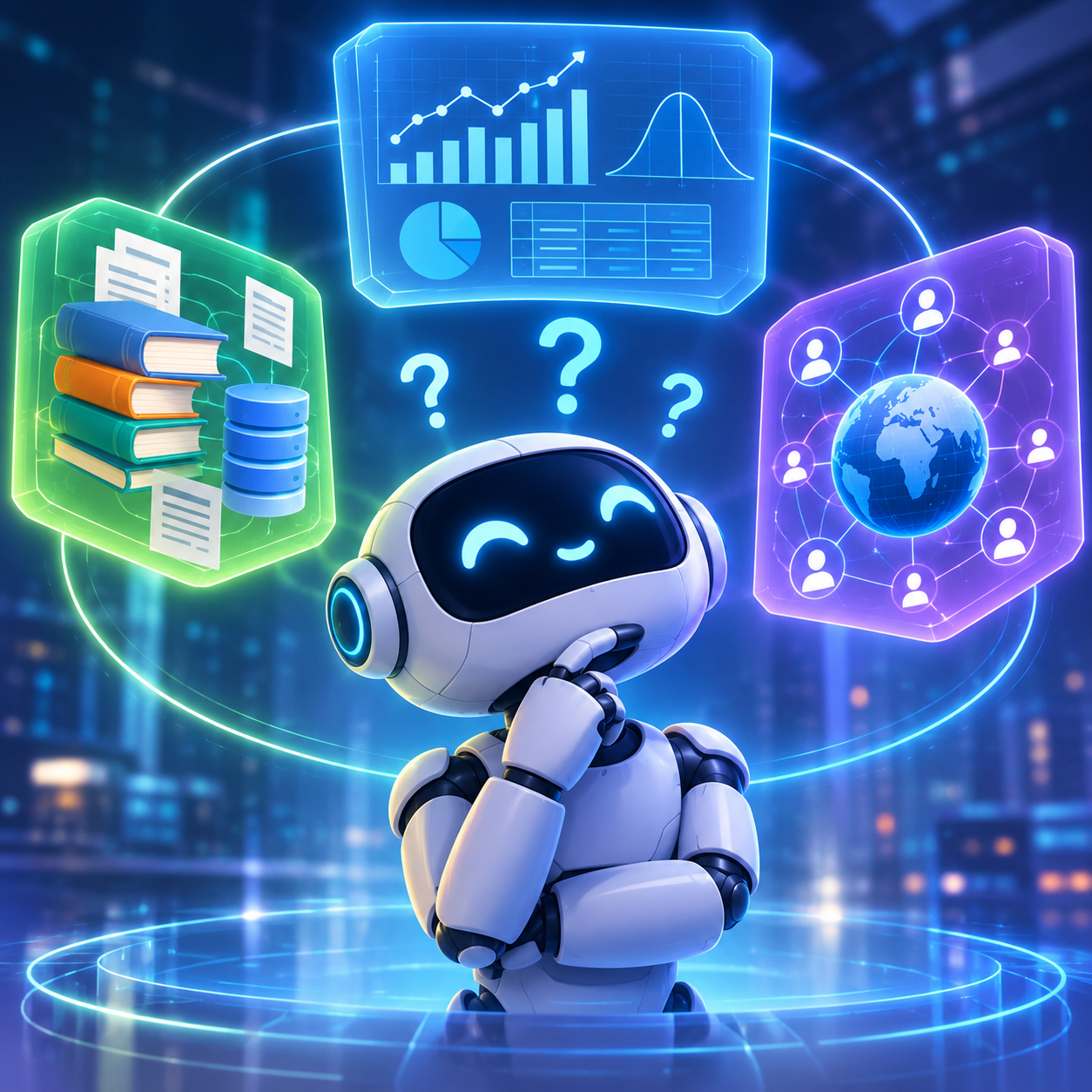
Language models, the latest wave of AI, excel at interpretation more than at certainties. Their fuzziness is detrimental to simple truths, but it yields knowledge machines that embrace complexity and cultural lenses.
Note
This post was originally published in French as part of my scientific chronicle in Les Echos.
Computers manipulate and store information. Seeing them as tools for knowledge is a natural step, especially with AI. Indeed, a long tradition of knowledge engineering led the AI “Watson” to victory in 2011 on the TV game show “Jeopardy”, answering convoluted trivia questions.
From knowledge carried by logic to analogies
Watson relied on knowledge bases: large registries accumulating established facts. But to be useful, a catalog must be given structure. Answering a question requires connecting its statement to known facts. For this, knowledge engineering uses logic, inferring, for example, that, as Vincent van Gogh was born in the Netherlands, he had Dutch nationality. The advantage of logic is that it does not make things up. Statements are either true or false, and symbolic AI –based on logic– invents nothing. The heavy task of consolidating knowledge falls on the human who fills in the knowledge base.
But the AI of language models proceeds by analogy more than by logic. These AIs write, generating new texts. They can “hallucinate” facts that do not exist. Their relationship to knowledge is more complicated, which has led some to see in these AIs an “epistemological bankruptcy”.
In our publication “Knowing with language models”, with Stéphan-Eloïse Gras, we argue that these connectionist AIs have strengths over the symbolic AIs, based on logic. Indeed, knowledge does not boil down to a simple true or false. For example, the question “how old is Paris?” can have several answers, depending on whether we go back to the Gallic history of the city or to Clovis choosing Paris as his capital. But there can also be difficulties of interpretation: in the context of Greek mythology, this question designates Paris of Troy, who is in his forties in the Iliad.
Fuzziness for nuances, with interpretations and cultural anchors
Language models hold knowledge in a continuous, sometimes fuzzy representation, in which words take their meaning from their context rather than from fixed categories as in a knowledge base. This fuzziness makes it difficult to anchor certainties. But it makes it possible to juxtapose information, and to implicitly consolidate knowledge from partially coherent texts. This is how the knowledge of language models is built, derived statistically from an astronomical amount of texts. Statistical accumulation is not neutral from every human standpoint, however, as the designers of the AI choose the texts that it digests.
Thus, a language model embeds in its knowledge the cultural lenses of its training texts. I asked Mistral (French), ChatGPT (American), and Qwen (Chinese) to pick the most important mathematical discovery; the first two cite infinitesimal calculus, by Newton and Leibniz, but the third chose the invention of zero, by Indian mathematicians.
The paper behind this chronicle
The research article that this chronicle draws on, “Connaître avec les modèles de langage : une rupture paradigmatique” (Knowing with language models: a paradigm shift), by Stéphan-Eloïse Gras and myself, is published in Intellectica and available here.
AI chronicles
Find all my AI chronicles here
The goals of these “AI chronicles” is to introduce concepts of AI to a broader public, staying at a very very high level.